Consumer spending in April fell 13.6% vs. a drop of 12.8% expected. Meanwhile, personal income saw a major increase of 10.5% vs. a decline of 5.9% expected. With tens of millions of people unemployed and many more facing economic uncertainty, it’s likely that spending came in below expectations as consumers exercised caution and frugal spending in recent weeks. Consumer spending in March was revised from a decline of 7.5% to a drop of 6.9%.
Key Takeaways
- Consumer spending fell 13.6% vs. the 12.8% decline forecast, the largest monthly drop since records began in 1959.
- Personal income rose 10.5% instead of dropping 5.9% as expected.
- The surge in income is partially due to the stimulus package issued by the government, as well as consumers spending far less of their income than expected.
Consumer spending saw the steepest drop ever last month, with an increasing number of people reserving spending for essential items only. Consumer spending typically accounts for two-thirds of all economic activity in the US. However, healthy sending requires a strong labor market, and the collapse of the labor market is now changing the landscape of the American economy.
Personal spending down 13.6%, personal income up 10.5% ( its government transfers to support unemployed) and savings up to 13.2%, which points to paradox of thrift. Makes point if income support fades, Q3'20 economic rebound will be damped noticeably. pic.twitter.com/b7hTIYBanN
— Joseph Brusuelas (@joebrusuelas) May 29, 2020
The coronavirus pandemic has created times of great economic uncertainty, negatively impacting many businesses nationwide. One in four retailer businesses are reportedly unsure if the business will survive to the end of the year, following the worst monthly drop ever in retail sales. The service industry and manufacturing industry have also taken major economic losses, and with over 40 million layoffs since mid-March, many people are likely uncertain as to their job stability in the coming months.
Road to Recovery
Now that some states are beginning to lift lockdown restrictions, economic activity is stirring once again throughout the US, but it’s unclear how long it will take to recover from the current crisis, and what the recovery will look like. “Some of the data suggests a stabilization,” said Kathy Bostjancic, chief U.S. financial economist at Oxford Economics. “It’s still overall a very tentative, slow recovery.”
Concern around the health of the economy began to mount in March, resulting in a sharp increase in savings at that time also. Government stimulus packages issued since March have also contributed to increased personal income, although many Americans are still struggling to make ends meet.
Income and Inflation
Income rose 10.5% in April, and March figures were revised from a 2% decline to a drop of 2.2%. Personal consumption expenditures (PCE) fell 0.5%. Core PCE, a measure used by the Fed to track inflation which excludes food and energy, remained flat. The PCE index rose 0.5% annually in April, down from 1.3% in the 12 months through March. Meanwhile, core PCE rose 1% last month compared to 1.7% the month before.
Market Reaction
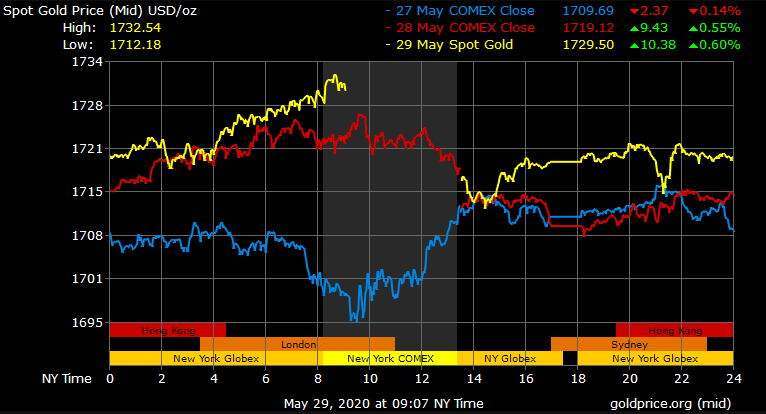
Gold prices have seen upward momentum following the release of the news of lower consumer spending. Spot gold last traded at $1,729.50/oz, up 0.60% with a high of $1,732.54/oz and a low of $1,712.18/oz. The record drop in consumer spending is significant, indicating a major undermining of the driving force of the US economy and creating a bullish climate for gold.