The number of new homes sold in the US in December surpassed expectations after November’s downwardly revised figure painted a bleak outlook for the struggling housing market. Lower mortgage rates and downwardly-adjusted home prices have increased affordability.
Key Takeaways
- Single-family homes sold at an annualized pace of 621,000 in December vs 597,000 expected.
- New home sales rose 3.7% vs the -8.6% drop predicted, a big miss in market expectations.
- Reduced mortgage rates over the last few months as well as more realistic seller expectations helped close a weak year for the market on a stronger note.
- Median sales price saw a 7.2% annual drop.
2018 was a weak year for the housing market with frequently dour reports in home sales and housing starts throughout. Market consensus was for sales to drop in December following a major jump reported in November which was later revised downward by 58,000.
Now at $318,600, median sales prices saw a 7.2% drop annually as sellers come to terms with the fact that many potential buyers cannot access the market. With sellers adjusting prices to suit market demand, affordability has increased and is most likely the cause behind the unforeseen hump. The average sales price was $377,000.
Mortgage Rates and Wage Gains
The number of homes for sale where construction hadn’t started rose to the highest point since the housing collapse of 2007, a sign that the price reduction may be sustainable with more supply on the way. With the drop in prices, wage gains are finally beginning to outpace home price increases which may also lead to more sustainable housing market growth.
Mortgage rates, which have fallen from 5% to 4.4% in recent months, have also provided some relief, and a strong labor market is undeniably holding it all together.
On the flip side, residential investment has had a negative impact on GDP in all four quarters of 2018, with an annual 0.2% contraction bringing home building investment to the lowest point since 2010. The latest reading for new home sales is still below the pace seen in early 2018.
New Home Sales Price Growth Year over Year (%) pic.twitter.com/PPDOnnVisG
— Eric Basmajian (@EPBResearch) March 5, 2019
Housing Starts Slow in December
Housing starts were reported to have dropped to the lowest point in years in December, although it’s possible that the government shutdown has disrupted the collection of accurate data during that time period. Today’s report was delayed by over a month due to the partial shutdown of the government beginning in late December and lasting 35 days. January and February figures are also delayed and due on March 14 and March 29 respectively.
In January, existing home sales fell to the slowest pace since 2015. This and other indicators led analysts to predict a poor result for new home sales in December, as existing home sales comprise the main share of the market.
However, new home sales are seen as a more current indicator of market activity.
Regional And Supply Data
New home sales rose in three out of four regions in December, with the Northeast seeing the biggest jump since 2015, and the Midwest seeing the biggest drop since April 2016.
The time it would take to sell the current supply at dropped from 6.7 months previously to 6.6 months at December’s pace. 344,000 new homes were available for sale at the end of the month, the highest since 2008.
Expert Outlook
Analysts agree that the combination of a strong labor market and increased wage gains would rekindle growth in the housing market at the current pace.
“As we head into 2019, we can expect continued strong employment growth and rising incomes which could support a re-acceleration in home-price appreciation later this year,” said Frank Martell, president and CEO of CoreLogic.
Market Reaction
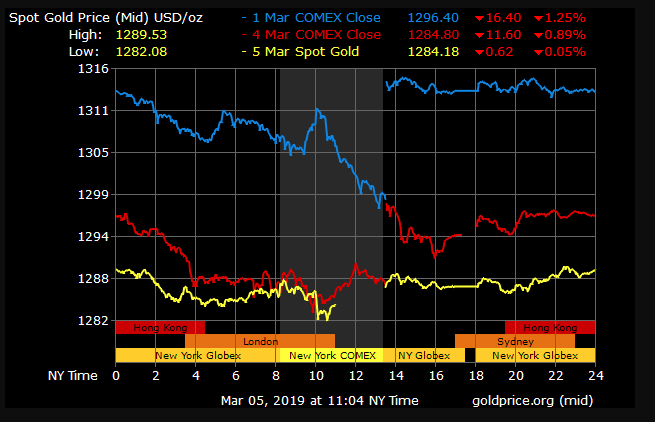
Spot gold prices reacted negatively to the unexpectedly strong housing market report. After testing a significant line of resistance at just under $1,290/oz, gold has dropped to $1,282.08/oz before recovering slightly and is now trading down -0.05% at $1,284.18/oz.
The delayed nature of the report makes it less relevant to the markets overall and it seems likely that barring a knee-jerk reaction to the news, a return to the mean could be on the way shortly.